Calculate a Spires purchase
Loading the interactive tool…
The Arkheron Spires economy is easiest to manage as a live checkout, not as a fixed floor-by-floor price list. In Early Access 1.0 evidence, a fresh Eternal Relic costs 150 Fragments, rank II and III upgrades add 300 and 500, and the official repeat-price escalation is 25. Consumables and Anchor prices can change with the checkpoint and purchase state, while Endless keeps the economy relevant across continued runs. Enter the Shrine quote you actually see, your balance, current ranks, prior purchases, and the consumables you want; the useful result is the Fragment balance that remains after checkout.
The calculator above is designed for that decision. Use it before committing the loadout, then compare its result with the Shrine's remaining-balance preview. A mismatch usually means a repeated item, an upgrade, a replacement credit, or a mode-specific price was counted incorrectly.

The Early Access 1.0 economy rules that matter
The official Early Access 1.0 patch notes make two current rules explicit: Spires item-price escalation is 25, reduced from 50, and Endless Spires no longer resets its economy between runs. The same notes recommend saving favorite items, delaying some upgrades, and taking an occasional eco round as prices become more restrictive.
The 150/300/500 sequence comes from two layers of evidence. The older official 0.23 patch notes published 150 for a starting Eternal item, 300 for rank II, and 500 for rank III. Launch-version Shrine recordings then show the same three amounts in Early Access play: 150 first purchases, isolated 300 and 500 upgrade previews, and completed rank III equipment. That makes the sequence useful for planning, but the live Shrine remains the final authority when an item's history or mode changes its quote.
| Decision | Verified planning value | How to apply it |
|---|---|---|
| Fresh rank I Eternal Relic | 150 Fragments | Use only when the Shrine shows the first-purchase price |
| Additional purchase of the same item | +25 escalation | Apply from the item's current purchase history, not from floor number alone |
| Rank I to rank II | 300 Fragments | Add once for the selected slot |
| Rank II to rank III | 500 Fragments | Add after rank II; rank I cannot jump to III for only 500 |
| Four fresh rank I Relics | 600 Fragments | Four separate 150 purchases |
| One fresh rank III Relic | 950 Fragments | 150 + 300 + 500 |
| One repeated-base rank III Relic | 975 Fragments | Observed as 175 + 300 + 500 in one launch loadout |
| Endless economy | No automatic between-run reset | Keep purchase history in the budget and verify every new Shrine quote |
Do not substitute Learning Spires prices for public Spires. One Learning Spires Shasur setup showed four rank III pieces totaling 3,000, or 750 each, which is a training configuration. The public planning sequence above totals 950 for a fresh item taken from rank I through rank III.
How to calculate a Spires checkout
1. Choose the correct state
Select standard Spires for Floors 1–10 or Endless for continued play beyond the standard climb. Record the exact floor because it helps identify the checkpoint and available budget, but do not calculate price from floor alone. Recorded launch shops showed the same Dahla crown at 175 on Floor 6, 225 on Floor 10, and 150 at the Floor 11 checkpoint. Purchase state and the transition matter more than the number printed beside the floor.
Training, Learning Spires, and Ascension are separate economies. A Collector Shrine price from Ascension is not a safe substitute for a purple Spires Shrine quote.
2. Record balance and current equipment
Copy the Fragment balance shown when the Shrine opens. Then record all four Relic slots, each item's rank, and whether the planned item is a fresh claim or a repeat. Empty slots do not erase earlier purchase history by themselves. If the interface already shows a price, use that number rather than reconstructing it from memory.
For a fresh rank I set, the basic cost is the sum of four item prices. For upgrades, add 300 for every slot moving from I to II and another 500 for every slot moving from II to III. A four-piece rank I set therefore starts at 600 when all four offers are 150. Taking all four fresh pieces through rank III would be 3,800 before consumables or an Anchor.
3. Add consumables and the Anchor separately
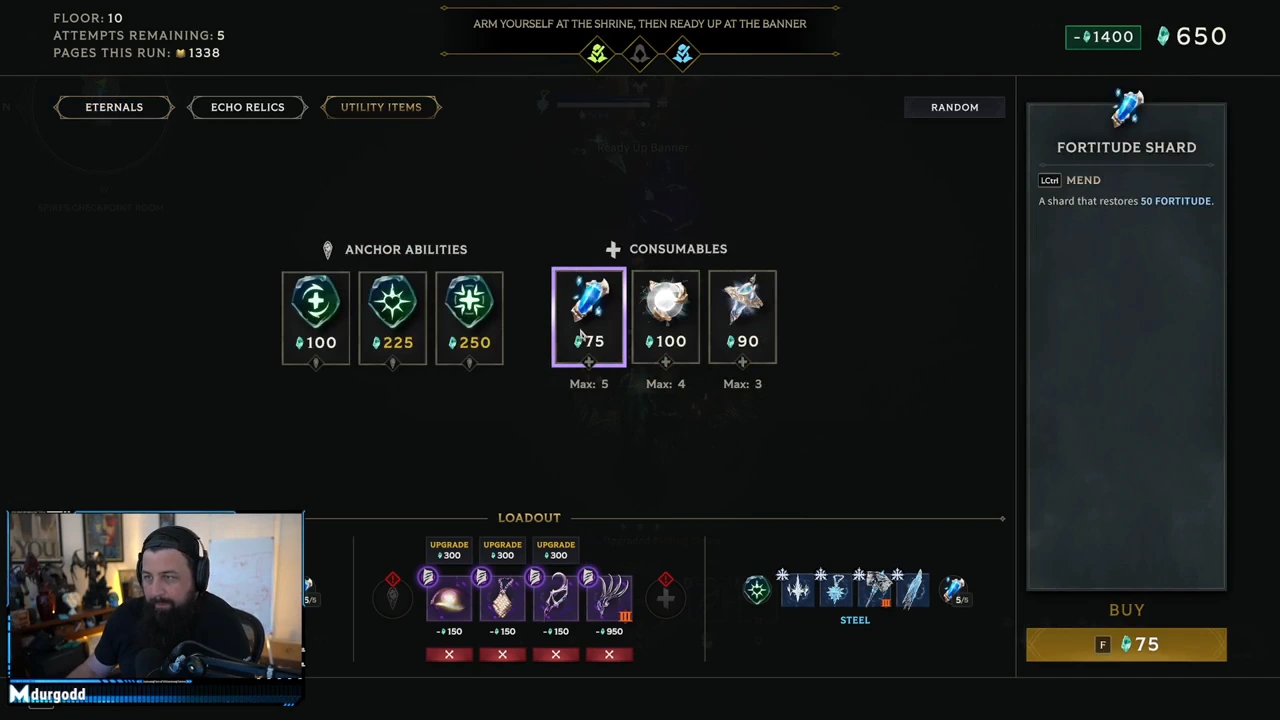
Consumables are real checkout costs, not free refills. Count the quantity you intend to leave with and multiply it by the current unit quote. In public launch evidence, Fortitude Shards cost 75 each in a Floor 1 checkout and again in a Floor 10 checkout. A Health Potion purchase in a 1.0.24 bot checkpoint cost 100.
Anchor prices are more state-sensitive. Mending Hands cost 100 in one public Floor 1 checkout and 250 in a Floor 10 checkout. That difference is why a global “Mending Hands price” is less reliable than the current tile. Enter the tile's displayed amount, and do not reuse the Ascension Collector price.
4. Subtract the complete plan
Use this order:
- Start with the visible Fragment balance.
- Subtract all four Relic claims or replacements.
- Subtract every selected rank upgrade.
- Subtract the Anchor.
- Subtract each consumable quantity.
- Keep the remainder as the battle reserve or next-checkpoint buffer.
A positive remainder means the displayed plan fits. Zero means every Fragment is committed. A negative result means the plan cannot be purchased as entered; remove an upgrade, change the loadout, or reduce consumables before confirming.
5. Verify the Shrine preview
The checkout is complete only when the calculator remainder matches the Shrine's remaining-balance preview and the post-shop HUD. Pending loadout lines can show a planned allocation that has not yet settled. If the numbers disagree, inspect one slot at a time for a repeat-price increase, a rank that was already purchased, a replacement credit, or an item left in the cart.
Worked budget: a Floor 1 Shattered loadout
A recorded public Spires Floor 1 checkout starts with 2,000 Fragments. The player buys Hollow's Companion Crown, Hollow's Outcast Amulet, Shasur's Twin Daggers, and Shasur's Fan of Blades at 150 each. The four Relics cost 600, leaving 1,400.
Mending Hands then costs 100, leaving 1,300. Five Fortitude Shards cost 75 each, or 375 total. The final calculation is:
2,000 - 600 - 100 - 375 = 925 Fragments
The transaction sequence confirms every step: the four Relic purchases move the wallet through 1,850, 1,700, 1,550, and 1,400; Mending Hands moves it to 1,300; five Shards move it through 1,225, 1,150, 1,075, 1,000, and finally 925. This is a useful first-floor template because it separates build cost from utility cost and ends on a settled HUD balance.
Worked budget: Floor 10 upgrades and utilities
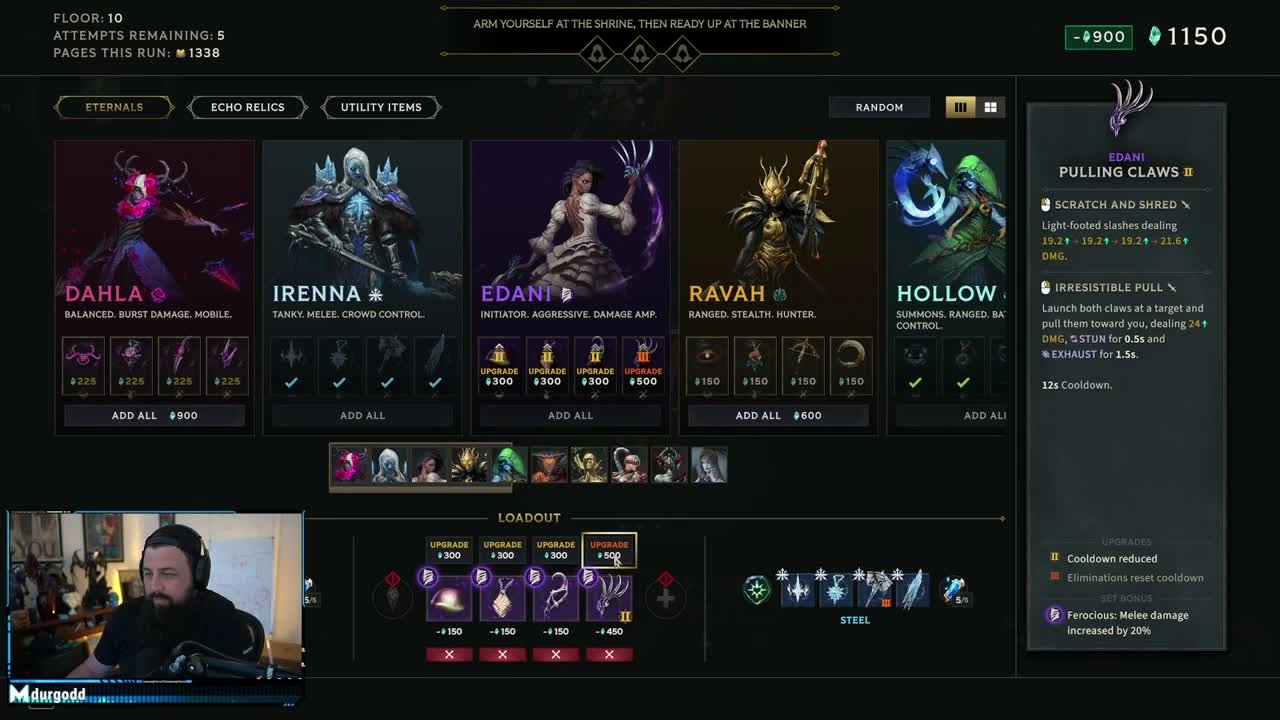
A separate Floor 10 shop opens with 2,050 Fragments. Four Edani rank I pieces account for 600, leaving a preview of 1,450. Pulling Claws moves from rank I to II for 300 and from II to III for 500, reducing the preview to 650.

Five Fortitude Shards at 75 each cost 375. Mending Hands costs 250 in this checkpoint. The complete ledger is:
2,050 - 600 - 300 - 500 - 375 - 250 = 25 Fragments
The recorded shop preview and the battle HUD both show 25 after checkout, while Pulling Claws appears at rank III. This example also shows the cost of upgrading only the key slot: upgrading every piece would have consumed far more than the available balance.
What changes at the Endless boundary
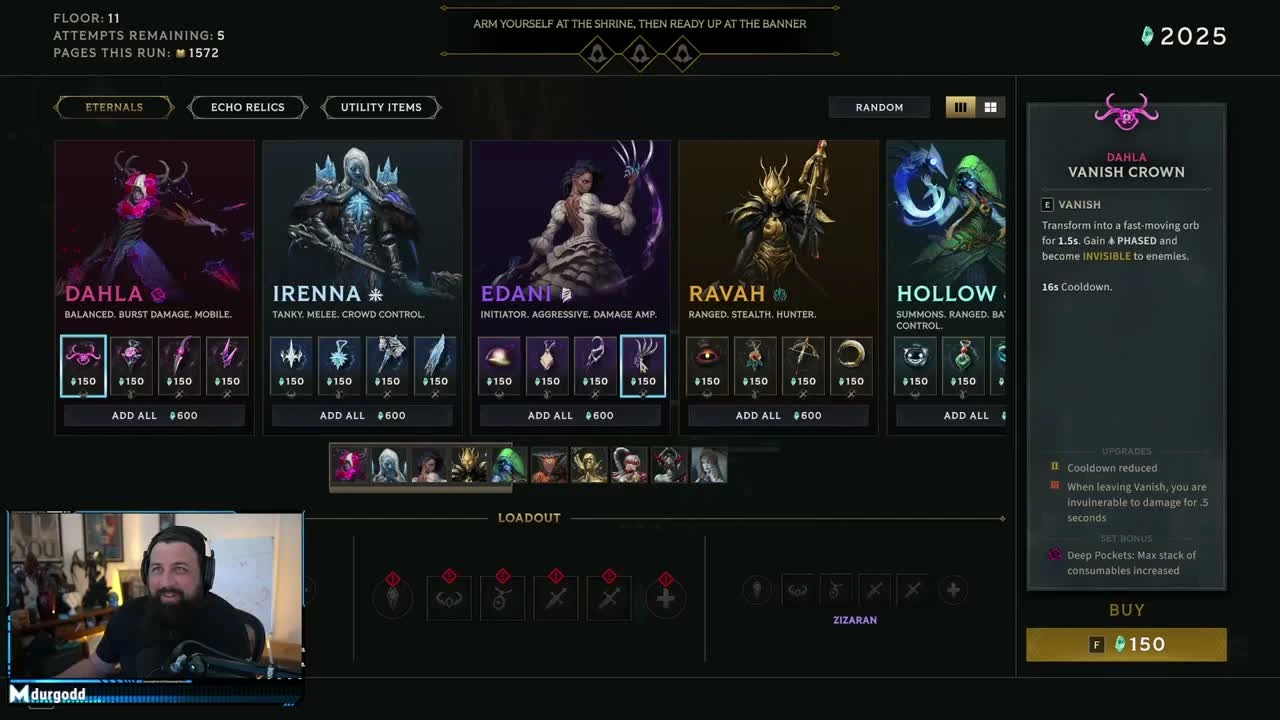
One recorded Floor 10 victory carried 1,572 Pages and five attempts into Floor 11. The player's battle wallet moved from 25 to 2,025, a net increase of 2,000, and the four equipment slots reopened empty. The same Dahla Vanish Crown that had shown 225 on Floor 10 showed 150 in the Floor 11 shop.

Treat those as observed transition facts, not a universal reward formula. The source does not isolate which reward component produced the 2,000 net change, and one transition cannot establish every future checkpoint payout. More importantly, the official 1.0 rule says Endless economy does not reset between runs. Do not use the lower Floor 11 crown quote to invent a general reset rule. Carry the economy state forward, then replace any estimate with the new Shrine quote as soon as it appears.
Two same-floor Floor 11 retry samples also showed a 2,000 net wallet increase before the next shop and empty slots, but the exact credit source was not isolated. This supports using the newly displayed wallet as the next calculation's starting balance; it does not support promising 2,000 for every retry.
Thirteen current shop checks behind the budget model
The following Early Access observations are individual purchases or isolated previews. They are included to show which arithmetic has a settled wallet, which is a live upgrade preview, and which values should not be generalized beyond the recorded context.
| Check | Floor | Item or action | Wallet change | Evidence type |
|---|---|---|---|---|
| 1 | 1 | Companion Crown rank I | 2,000 → 1,850 | Paid |
| 2 | 1 | Outcast Amulet rank I | 1,850 → 1,700 | Paid |
| 3 | 1 | Twin Daggers rank I | 1,700 → 1,550 | Paid |
| 4 | 1 | Fan of Blades rank I | 1,550 → 1,400 | Paid |
| 5 | 1 | Mending Hands | 1,400 → 1,300 | Paid |
| 6 | 1 | Fortitude Shard 1 | 1,300 → 1,225 | Paid |
| 7 | 1 | Fortitude Shard 2 | 1,225 → 1,150 | Paid |
| 8 | 1 | Fortitude Shard 3 | 1,150 → 1,075 | Paid |
| 9 | 1 | Fortitude Shard 4 | 1,075 → 1,000 | Paid |
| 10 | 1 | Fortitude Shard 5 | 1,000 → 925 | Paid |
| 11 | 10 | Pulling Claws I → II | 1,450 → 1,150 | Isolated preview, later committed |
| 12 | 10 | Pulling Claws II → III | 1,150 → 650 | Isolated preview, later committed |
| 13 | 2 training | Health Potion | 1,900 → 1,800 | Paid in 1.0.24 bot checkpoint |
The four first purchases establish the 150 launch price in one continuous public checkout. The five Shard entries establish repeated 75 deductions rather than one inferred 375 bundle. The two upgrade previews change only the selected weapon, and the later HUD confirms rank III. The potion remains labeled as a bot-checkpoint sample so it is not mistaken for a universal public-shop rule.
Common calculation failures
Using the old 50 escalation. Version 0.23 used a 50 increase. Early Access 1.0 changed the escalation to 25. A guide that carries forward the old step will overstate repeated-item costs.
Treating every 150 as a permanent base. A 150 first purchase is well supported, but repeated quotes of 175 and 225 also appear. Use the current tile once purchase history exists.
Counting a rank III upgrade as 500 total. The 500 price is the II-to-III step. A fresh rank III item uses the base purchase plus the 300 and 500 upgrades.
Mixing preview and settlement. Adding and removing pending gear can change the projected balance without completing a purchase. Verify the post-shop HUD before treating a loadout as paid.
Mixing Pages with Fragments. Pages track run progress and rewards; Fragments fund the Shrine checkout. Carry them as separate values even when both persist into the next checkpoint.
Assuming empty slots mean a clean economy. Recorded transitions can reopen with empty slots while the broader Endless economy continues. Empty equipment and purchase history are different inputs.
Copying Learning or Ascension prices. Learning Spires has training configurations, and Ascension's Collector Shrine has its own prices. Neither replaces the live public Spires quote.
When to save, upgrade, or take an eco round
Buy the four rank I pieces first when completing the intended set changes the build more than one high-rank slot would. At 150 each, a fresh four-piece set costs 600, while taking one fresh item all the way to rank III costs 950. That comparison favors completing the build before stacking upgrades unless the selected upgrade is central to the plan.
Upgrade the key weapon or ability first when the build already functions at rank I. The Floor 10 example spends 800 on one slot's two upgrades and still fits the required consumables and Anchor by finishing at 25. Upgrading several slots without checking utilities can leave a technically stronger loadout with no Fortitude or recovery option.
Take an eco round when repeated-item escalation or multiple upgrades would consume the next checkpoint's flexibility. The official patch guidance explicitly recognizes saving favorites, holding upgrades, and occasional eco rounds as part of Endless strategy. “Eco” does not mean spending nothing; it means setting a reserve target first and buying only what keeps the current loadout functional.
The safest target is not a universal number. Choose a reserve based on the next utility you refuse to lose, then run the calculation again. If the preview falls below that reserve, delay the least important upgrade. Once the Shrine settles, confirm the final wallet on the HUD and use that exact number as the starting balance for the next checkpoint.