Choose your Spires route
Loading the interactive tool…
Standard Spires is a three-versus-three climb through ten floors. At each checkpoint, your team builds loadouts before fighting another team in a round-based match. Win the floor to keep climbing; lose too many attempts and the run ends. Once you conquer Floor 10, you may finish the standard run or continue into Endless Spires.
The current Early Access rules use win-by-two scoring with a seven-round cap. A close match can therefore reach 3–3 before one final deciding round. Economy decisions also become more important in Endless because the economic state no longer resets between runs. These rules come from the official Early Access 1.0 patch notes and verified launch-client recordings.
Choose the Right Spires Mode
Arkheron presents several versions of Spires, but they do not serve the same purpose. Choose the mode that matches the skill you need to practice instead of treating every queue as equivalent.
| Mode | Verified structure | Best use |
|---|---|---|
| Learning Spires | Three introductory 3v3 floors in Early Access 1.0 | Learn checkpoint shopping, upgrades, executions, consumables, and Anchor abilities |
| Training Spires | Matches with two friendly bots, selectable difficulty, and bot opponents | Test movement, ability timing, and unfamiliar Relics without entering PvP |
| Standard Spires | A ten-floor 3v3 PvP run with limited attempts | Complete the real climb and practice adapting to human opponents |
| Endless Spires | Continued climbing after Floor 10 | Test long-run economy management and repeated loadout adaptation |
New players should finish Learning Spires first, then use Training Spires if they still need time to read item cards or execute abilities under pressure. Training is useful preparation, but it does not reproduce the decisions made by a human team. Move to Standard Spires when you can recognize your four equipped abilities, identify your set bonuses, and communicate one simple target or positioning plan.
How a Standard Spires Floor Works
Every floor has two distinct phases: a checkpoint and a fight. The checkpoint is where you inspect the matchup, configure equipment, buy supporting items, and ready up. The fight is a series of short rounds against one opposing team.

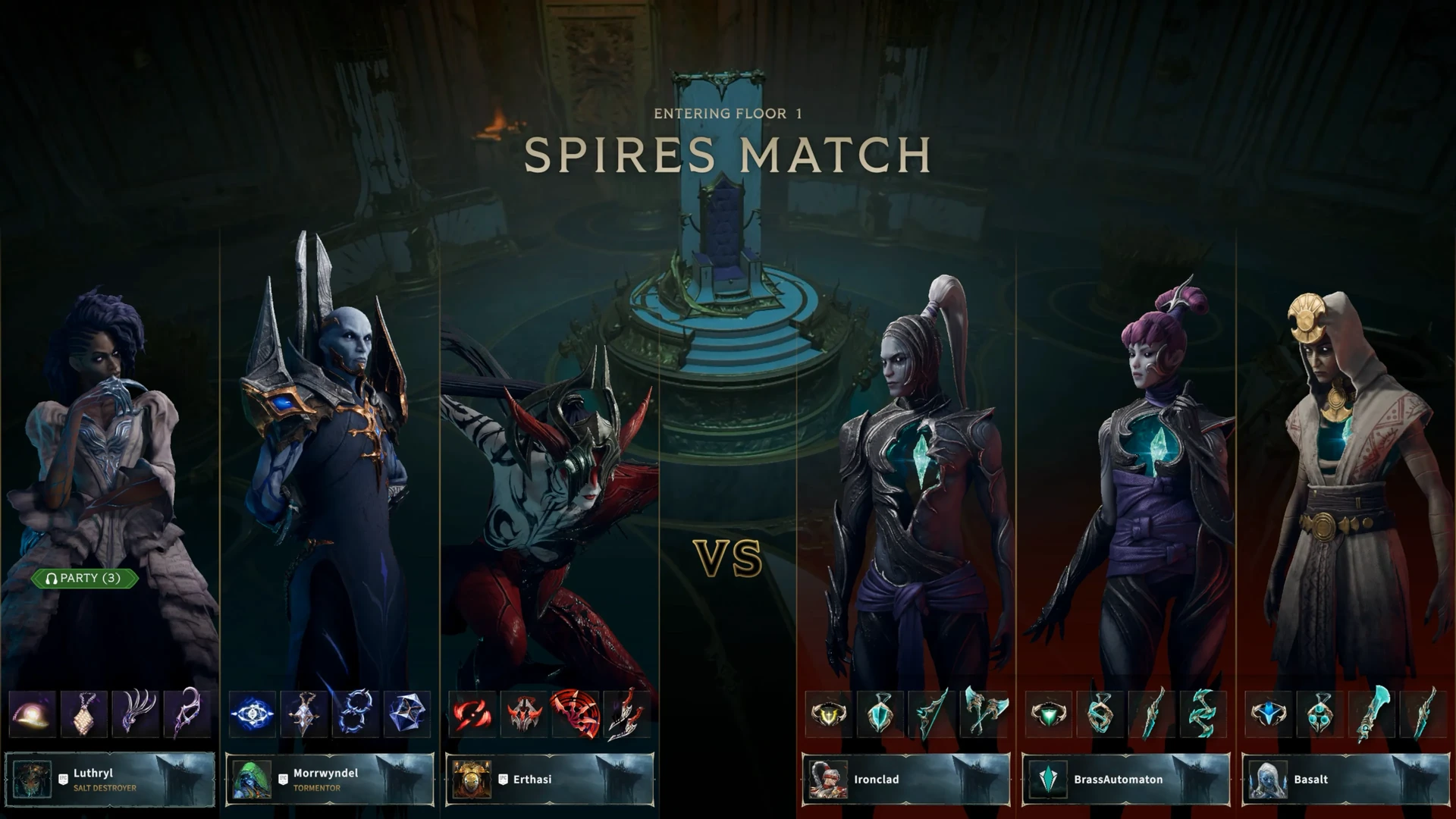
The matchup screen shows both teams and their four-slot loadouts. Use it as information, not decoration. Assign one teammate to call out the enemy’s most obvious range, sustain, displacement, or defensive threat. The other two players should confirm whether the planned build can reach that threat and survive its strongest engage.
Your four Relics determine your active kit. Two Relics from the same Eternal activate that set’s two-piece bonus, while all four pieces transform you into that Eternal and grant a fifth ability. The official game overview explains this build system. A full transformation is powerful, but it is not automatically correct for every matchup; a two-plus-two combination can preserve tools from two different sets.
Understand the Win-by-Two Rule
Spires does not always end after three rounds. Under the Early Access 1.0 rule, a team must win by two rounds, but a match cannot exceed seven rounds. Straightforward results can end quickly, while close games continue so that neither team wins on a one-round margin before the cap.
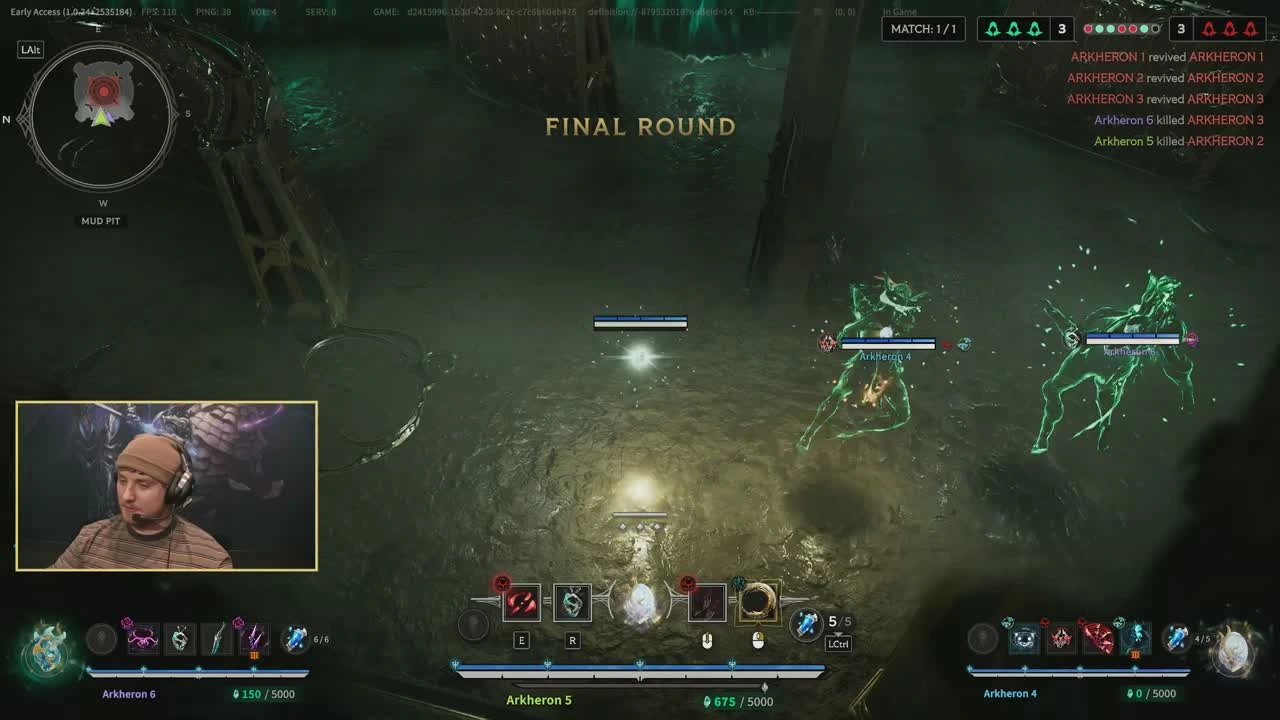
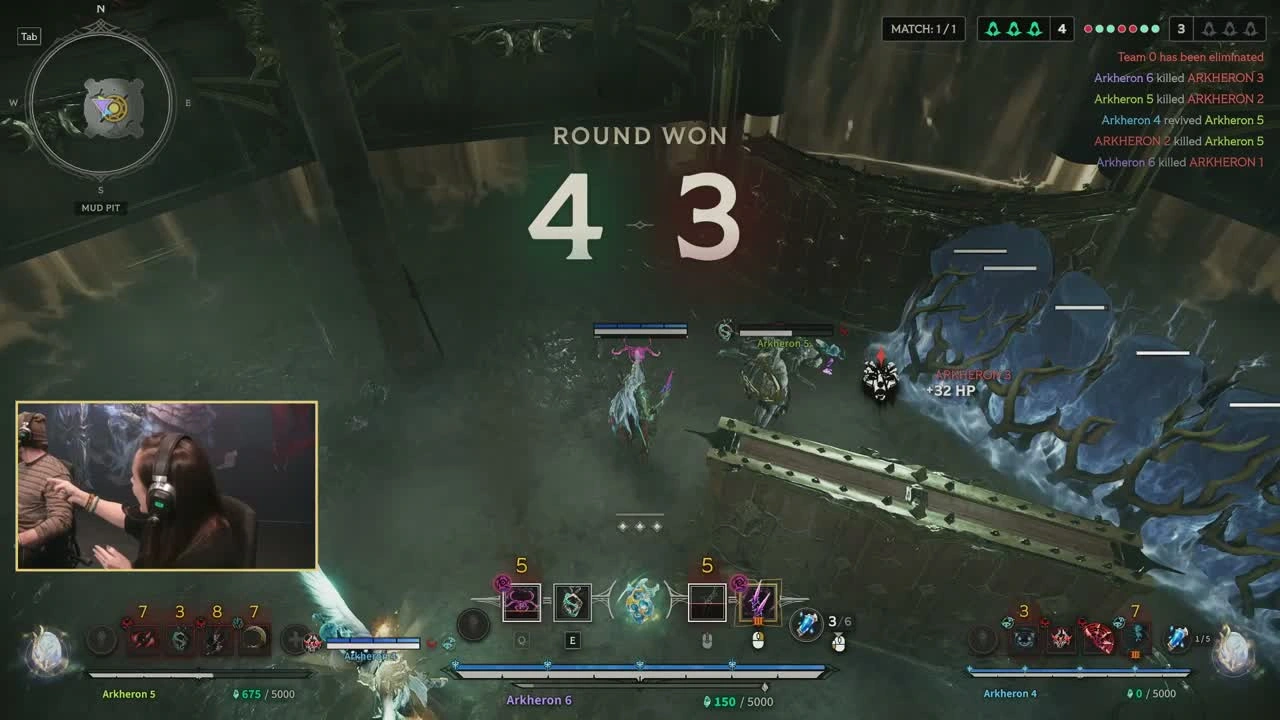
The important edge case is 3–3. The next round is explicitly the final round, so the winner takes the floor 4–3. An official DreamHack match on client build 1.0.24+2535184 showed the FINAL ROUND banner at 3–3 and then ended 4–3. A separate launch-weekend public match reproduced the same sequence.

Treat 3–3 as a fresh one-round match. Created objects are cleared between rounds, and earlier momentum does not give your team an extra life. State the target, the opening path, and the defensive response before the countdown ends. This is the wrong moment for three players to make separate improvisations.
Run Your First Ten-Floor Climb
A complete first attempt is easier when the team repeats the same small decision cycle on every floor. Do not try to design ten separate plans in advance; use each checkpoint and round result to update the next decision.
1. Divide the Checkpoint Work
Give each player one responsibility while shopping:
- Matchup reader: checks enemy Relics and identifies the ability or range profile most likely to decide the fight.
- Economy caller: watches available Fragments, planned purchases, upgrades, consumables, and Anchor coverage.
- Execution caller: defines the first target, preferred fighting distance, and regroup signal.
These are temporary jobs, not rigid combat roles. Their purpose is to stop all three players from silently browsing the store until the timer expires. Before readying up, each person should be able to say what their build contributes and what situation forces a retreat.
If you do not understand the available items, Random Loadout can choose gear you can afford. The official notes state that it tries to fill consumables and favors Eternal items over Echo items. It is a recovery tool for an unfamiliar or time-limited checkpoint, not proof that the generated loadout is the best counter to the opposing team.
2. Build Around a Fight Plan
Start with the action your team can perform together. A ranged composition may want clear sightlines and disengage tools. A close-range composition needs a safe way to cross space without arriving one player at a time. A sustain-oriented group should avoid spending all its defensive cooldowns on the first enemy feint.
Then inspect how the four equipped Relics support that action. Do not purchase an upgrade merely because it is available. An upgrade that improves an ability you cannot safely use may contribute less than a consumable, an Anchor ability, or a replacement Relic that fixes the matchup.
Confirm four things before readying up:
- all three players know the first focus target;
- at least one player can answer an enemy engage or rescue a pressured teammate;
- the team understands whether it wants open space, cover, or a narrow approach;
- nobody has mistaken a shop preview for a completed purchase.
3. Use the First Round to Collect Information
The opening round is not only about scoring first. Watch which enemy starts the engage, which defensive ability prevents a kill, and whether the opposing team separates while chasing. Report observable actions rather than vague judgments: “their ranged player stays behind the wall” is actionable; “their build is broken” is not.
After the round, change one thing with a clear purpose. Switch the opening path, delay a key cooldown, or collapse on a different target. Changing the entire plan after every loss makes it impossible to tell which adjustment worked.
When ahead, keep testing the condition that produced the lead. Do not turn a controlled 2–0 position into three solo chases. When behind, identify the earliest point where the round became unfavorable. The final elimination is often a consequence of an earlier positioning or cooldown error.
4. Read the Floor Result Correctly
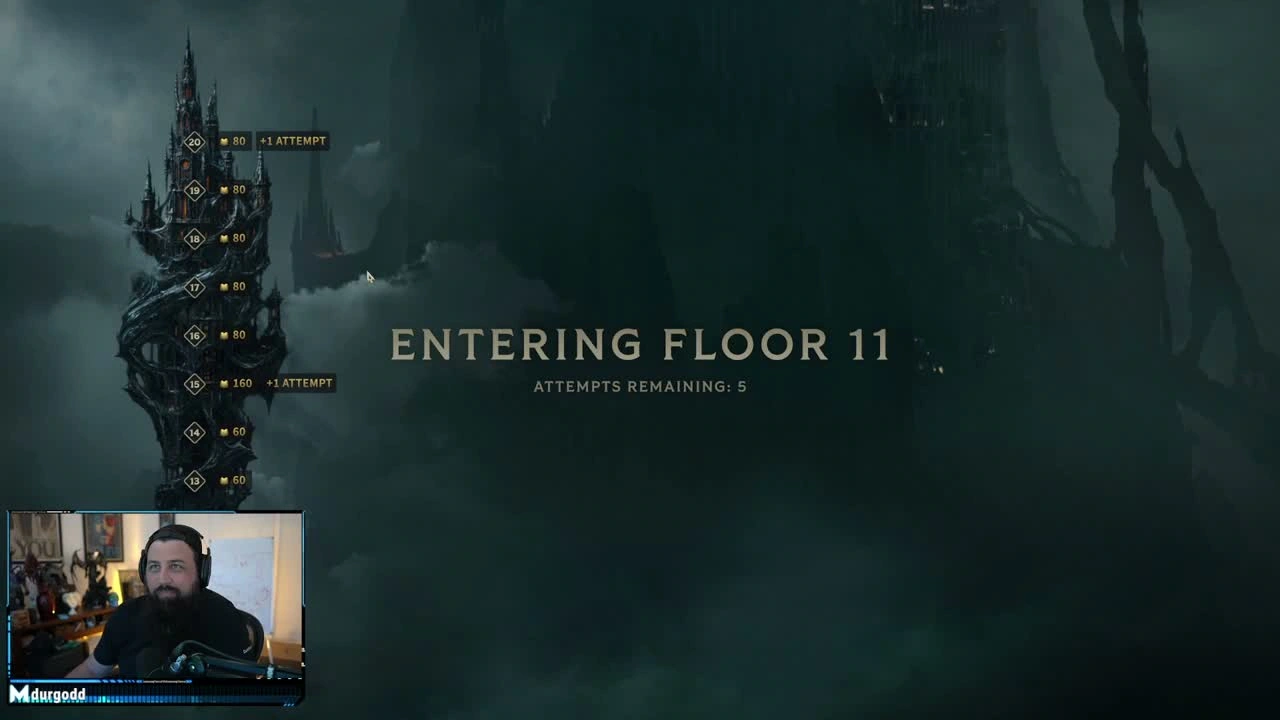
A victory advances the run. A defeat consumes an attempt and can return the team to the same floor. Launch-client footage from Floor 11 showed consecutive defeats followed by retries on Floor 11, with the visible attempt count falling from five to four after the next loss.
Do not confuse attempts with round losses. Dropping one combat round is part of the current floor match; losing the complete match is what puts the run’s remaining attempts at risk. The release-client checkpoint text showed three initial attempts and one additional attempt every five floors. Check the current climb screen rather than relying on an old reward table, because test-era progression values have changed.
Manage Fragments Without Assuming Fixed Rewards
Checkpoint economy should be evaluated as a sequence, not one isolated purchase. Early Access 1.0 reduced repeat-purchase price escalation to 25, making Floors 1–10 more forgiving. The official guidance still recommends saving favorites, delaying some upgrades, and occasionally taking an economy round before Endless pressure accumulates.
An economy round means intentionally spending less so that later checkpoints preserve more options. It does not mean deliberately throwing the match. Keep a functional build, agree on the limited purchase plan, and play for a clean win. If the cheaper setup cannot execute any coherent strategy, the saving has already cost too much.
Avoid publishing or memorizing one supposedly universal Pages reward or checkpoint wallet value. Verified launch recordings show that observed totals and match rewards vary by run. The useful stable decisions are whether you can afford the planned configuration, what will become more expensive after another claim, and whether a purchase solves the present matchup.
Three habits prevent most checkpoint mistakes:
- compare the final checkout balance, not only individual item labels;
- reserve enough time for all three players to verify their completed equipment;
- keep a cheaper fallback build ready when the preferred set becomes inefficient.
Adjust Your Strategy as the Run Progresses
Floors 1–3: Establish a Repeatable Plan
Use the opening floors to confirm that the team’s chosen range, engage, and defensive response work together. Learn who makes the target call and who watches for flanks. A win does not prove the build has no weakness, so note which enemy ability forced the most awkward reaction.
Do not overfit to Learning Spires prices or bot behavior. Learning is an onboarding environment, while Standard Spires uses human opponents and its live economy. The skills that carry over are reading the checkpoint, executing abilities, and regrouping after pressure.
Floors 4–7: Prepare a Second Configuration
By the middle of the climb, repeated claims and upgrades should influence your choices. Identify a second loadout family before the preferred configuration becomes restrictive. This alternative should preserve the team’s core job while changing a vulnerable dimension, such as range, mobility, or sustain.
This is also where the matchup reader should become more specific. Instead of naming only the enemy Eternal, identify the exact Relic or set bonus shaping the fight. The four-slot matchup view provides enough information to distinguish a complete transformation from a mixed build.
Floors 8–10: Protect the Run, Not Your Favorite Build
Late in the standard climb, unnecessary experimentation has a higher cost. Use the build with the clearest shared execution plan, preserve remaining attempts, and avoid upgrades that leave no room for a required consumable or Anchor.
Before Floor 10, decide whether the team intends to stop after completing the standard run or continue into Endless. That decision changes how aggressively you should exhaust short-term options. A team planning to continue needs a broader economic plan than one treating Floor 10 as the finish line.
What Happens After Floor 10
Conquering Floor 10 completes the standard ten-floor objective. Verified launch footage showed a SPIRE CONQUERED screen followed by a countdown into the next checkpoint, with LEAVE MATCH available. The same run then entered Floor 11 with its Pages total and five attempts still visible.

That transition also clarifies an easy misunderstanding: “the economy never resets” does not mean the four equipped Relics remain in their slots forever. In the verified Floor 10-to-11 sequence, the player’s four slots were filled during the Floor 10 fight and empty when the Floor 11 store opened. The run’s economic state, attempts, and Pages continued, but the checkpoint still required a new loadout configuration.
Endless is therefore a test of adaptability rather than possession of one finished build. Repeated purchases become increasingly consequential, and the official advice to hold upgrades or use economy rounds matters more as the climb continues. Verified footage reached Floors 13, 16, 17, and 20, but those observations should not be converted into a promised maximum floor. The supported conclusion is that the climb continues beyond Floor 10 and that later-floor economy and remaining attempts determine how long the run survives.
Common Spires Mistakes
Treating Training Results as PvP Proof
Bots are useful for rehearsing inputs and recognizing effects. They do not establish that a build will beat coordinated human opponents. Use Training to answer “Can I operate this kit?” and Standard Spires to answer “Can our team execute it against adaptation?”
Shopping Without Reading the Opponent
A familiar build may still be a poor response to the displayed enemy loadouts. At minimum, identify their likely engagement range, defensive reset, and complete Eternal transformations before committing your purchases.
Spending Every Available Fragment
An affordable upgrade is not automatically valuable. Spend for the next fight plan, while preserving flexibility for later checkpoints. This becomes especially important if the team continues into Endless.
Splitting the Team After a Round Win
A round lead often encourages overconfidence. Preserve the positioning and focus-fire pattern that created the advantage. The win-by-two rule gives a close opponent time to adapt, and a 3–3 match still ends with one decisive round.
Entering Endless by Accident
Read the Floor 10 result screen. Leave if the team intended only to complete the standard run. Continue only when everyone understands that attempts and economic pressure carry into the extended climb.
First-Run Completion Checklist
Your first Standard Spires run is ready when the team can answer yes to each item:
- We know Standard Spires has ten floors and uses 3v3 matches.
- We distinguish combat-round losses from a lost floor attempt.
- We know a 3–3 score triggers the seventh and final round.
- We inspect both teams’ four-slot loadouts before readying up.
- We assign a target, preferred range, and retreat condition.
- We check the completed purchase state instead of trusting previews.
- We adjust one identifiable problem after a lost round.
- We have a second configuration when repeated purchases become inefficient.
- We decide before Floor 10 whether to leave or enter Endless.
- We understand that Endless preserves economic pressure even though equipment slots are rebuilt at checkpoints.
The run is complete when SPIRE CONQUERED appears after Floor 10. From there, leaving records the standard completion, while continuing moves the same climb into Endless Spires.